Wednesday, September 12, 2012
This Blank Page
This blank page,
Oh how it mocks me.
"Ha ha ha, he he he,
You can't write on me."
So many images in my head,
Yet I can't make sense of them,
This goes here, that goes there,
This one doesn't fit anywhere.
Placed in a cage,
the page has captured me.
"Ha ha ha, he he he,
They'll be no escaping me."
So many emotions swirling within.
Why can't I make sense of them?
Write it like this, write it like that,
No that doesn't work so try again.
Dear blank page,
Your beauty has captured me.
Ha ha ha, he he he,
But you have no power over me.
So many ideas I have to write down,
You shan't stop me from writing them.
Pen markings here, pencil ones there,
Scratchpads and notebooks full.
This is not a cage,
No it has freed me,
Ha ha ha, he he he,
a blank page is a clean slate for me.

Wednesday, September 5, 2012
A Challenge of Silence
Honestly, I'm not sure what made me decide to write this...let alone put it up here on my blog. I only hope that someone reading this benefits from it. What I'm writing about has nothing to do with English or literature, or anything like them. It has to do with silence.
Silence, according to Webster's New World Dictionary is the absence of sound, but have you ever listened to a silent room? You should give it a try if you haven't, because the funny thing about silence is that it's not always silent. In my experience, it's never been completely silent. There's always been something...some noise...that disrupts it. Yet, that something is a part of the silence.
In all honesty, I don't think I could stand to be in a place where it is completely silent. Growing up with three younger siblings and sleeping in a house where you can hear street races kind of does that to you. If I went deaf I'd probably go crazy. Sound has played that big of a role in my life.
Going deaf and losing your sense of hearing is not what this post is about, however. No, it's about something else. It's about something that I want you to do.
I want you to do something. Something that tends to calm me during times of stress and worry, during times when I'm unable to stop thinking. I want you to go to a room, and I want you to shut off all electronic devices. Computers, phones, televisions, radios, iPods...turn them all off. If you must have your cell phone at least change its setting to either silent or vibrate.
Now, lay on the floor. The lights can remain on or off (I normally shut them off if it's during the day), but lay on the floor in the center of the room. If that's possible. Actually, it really doesn't mater where you lay, I just find laying on the floor to be less distracting for some reason.
Once you're laying down, where ever you're laying down at, place your arms beside you so your hands are flat on the surface beneath you. Make sure your legs are out stretched, not bent, and close your eyes. Calm your breathing. Focus on your breaths until you feel yourself relaxing.
Let yourself drift away. Become part of the room instead of being a disturbance in it. Don't open your eyes and keep breathing. Inhale...exhale..inhale...exhale.
Do you feel yourself relaxing? Good.
Now stop focusing on your breaths. Allow your quieted mind to observe the silence around you. Keep your eyes closed though. You don't need your sight to see the beauty of silence.
Slowly I want you to pick apart the silence. Grab a hold of one sound, like the hum of a passing car, before locating another. Make a mental list of all the sounds you hear. Notice how each sound adds something to the silence, just like how a speck of spice adds its own unique flavor to a soup.
After fifteen or twenty minutes you have my permission to turn on music, but keep it low and soft. You don't want it breaking the silence, for silence is a fragile thing. Also, use a radio...not an iPod or MP3 player. The earbuds/headphones of iPods allow you to drown out the silence to easily.
Stay like that, quiet and observant for sometime. You may find yourself dozing off and that's quite alright. If you do, you're probably pretty relaxed.
By this point you're probably wondering why I'm challenging you to do this . Really, what is the purpose of listening to silence? It's to listen and learn. Listen to the world around you, to the little sounds that you take for granted everyday, and to hear your own inner thoughts. Learn from the silence.
You can call me crazy, but I believe we can learn much from silence. Sometimes, when I do this activity, I don't just lay their listening to nothing. I lay there and marvel at the awesomeness of the Creator. I think about life and how precious it is, I think about how much God loves us (Yes, I'm a Christian), I think about all the little things that He gave us and we take for granted (such as our senses), and I think about how powerful silence can be.
Once you finish this activity, should you choose to do it, I hope you come out feeling as peaceful as I do.
Let's face it, life's not perfect. Everything may not be right in your world. You may have something you're fighting with, but sometimes all it takes is a moment of silence to give you the second breath you need in order to deal with life.
Silence truly is powerful.
Silence, according to Webster's New World Dictionary is the absence of sound, but have you ever listened to a silent room? You should give it a try if you haven't, because the funny thing about silence is that it's not always silent. In my experience, it's never been completely silent. There's always been something...some noise...that disrupts it. Yet, that something is a part of the silence.
In all honesty, I don't think I could stand to be in a place where it is completely silent. Growing up with three younger siblings and sleeping in a house where you can hear street races kind of does that to you. If I went deaf I'd probably go crazy. Sound has played that big of a role in my life.
Going deaf and losing your sense of hearing is not what this post is about, however. No, it's about something else. It's about something that I want you to do.
I want you to do something. Something that tends to calm me during times of stress and worry, during times when I'm unable to stop thinking. I want you to go to a room, and I want you to shut off all electronic devices. Computers, phones, televisions, radios, iPods...turn them all off. If you must have your cell phone at least change its setting to either silent or vibrate.
Now, lay on the floor. The lights can remain on or off (I normally shut them off if it's during the day), but lay on the floor in the center of the room. If that's possible. Actually, it really doesn't mater where you lay, I just find laying on the floor to be less distracting for some reason.
Once you're laying down, where ever you're laying down at, place your arms beside you so your hands are flat on the surface beneath you. Make sure your legs are out stretched, not bent, and close your eyes. Calm your breathing. Focus on your breaths until you feel yourself relaxing.
Let yourself drift away. Become part of the room instead of being a disturbance in it. Don't open your eyes and keep breathing. Inhale...exhale..inhale...exhale.
Do you feel yourself relaxing? Good.
Now stop focusing on your breaths. Allow your quieted mind to observe the silence around you. Keep your eyes closed though. You don't need your sight to see the beauty of silence.
Slowly I want you to pick apart the silence. Grab a hold of one sound, like the hum of a passing car, before locating another. Make a mental list of all the sounds you hear. Notice how each sound adds something to the silence, just like how a speck of spice adds its own unique flavor to a soup.
After fifteen or twenty minutes you have my permission to turn on music, but keep it low and soft. You don't want it breaking the silence, for silence is a fragile thing. Also, use a radio...not an iPod or MP3 player. The earbuds/headphones of iPods allow you to drown out the silence to easily.
Stay like that, quiet and observant for sometime. You may find yourself dozing off and that's quite alright. If you do, you're probably pretty relaxed.
By this point you're probably wondering why I'm challenging you to do this . Really, what is the purpose of listening to silence? It's to listen and learn. Listen to the world around you, to the little sounds that you take for granted everyday, and to hear your own inner thoughts. Learn from the silence.
You can call me crazy, but I believe we can learn much from silence. Sometimes, when I do this activity, I don't just lay their listening to nothing. I lay there and marvel at the awesomeness of the Creator. I think about life and how precious it is, I think about how much God loves us (Yes, I'm a Christian), I think about all the little things that He gave us and we take for granted (such as our senses), and I think about how powerful silence can be.
Once you finish this activity, should you choose to do it, I hope you come out feeling as peaceful as I do.
Let's face it, life's not perfect. Everything may not be right in your world. You may have something you're fighting with, but sometimes all it takes is a moment of silence to give you the second breath you need in order to deal with life.
Silence truly is powerful.
Sunday, September 2, 2012
My Thoughts On: The Perks of Being a Wallflower.

However, over the summer, I did manage to get through a few books on my list and today I would like to discus one of them. As you can tell from the title of this post, the book I'll be talking about is The Perks of Being a Wallflower (Stephen Chbosky).
I first heard of The Perks of Being a Wallflower while sitting in a Teaching Young Adult Literature class last April. Each of us students were required to choose a young adult book, read it, and then present it to the class. The book I chose was The Body of Christopher Creed (Carol Plum-Ucci), but one of my classmates had chosen Stephen Chbosky's The Perks of Being a Wallflower. It was while listening to her presentation on Chbosky's work that I became interested in it and decided to check it out.
To say The Perks of Being a Wallflower was an uneasy read would be accurate, in my opinion. The language and writing style -which I will talk about more in depth later -were easy to read, but it was the emotions that sprang from the pages that made it a difficult read. No, difficult isn't exactly the right word. It was like the emotions followed you even after you sat the book down.
Often times I had to leave the book on my bed for awhile just so I could try to wrap my own mind around Charlie's emotions. This book is haunting, no doubt about it.
Before I get into the themes, which will most likely help you understand why I call this book haunting, allow me to introduce you to the characters. Now, there's a decent sized list of characters, but I'm, only going to really explain three of them. These three are the ones I consider to be the main characters.
Characters:

Charlie is the narrator of the story and is a high school freshman. He is just beginning to really understand the world around him and has some dark memories that he has blocked out. He slowly begins to recall theses memories as the book progresses and it's because of the help of his friends that he makes sense of them all.
It's because of his English teacher, Bill, that he discovers his love for literature and writing. This causes Charlie to wish to become a writer and he begins trying to write stories.
Charlie lives with his mom, dad, college age brother, and older sister. He is referred to as a wallflower in the book because of his watch-listen-understand-but-stay-on-the-sidelines personality.
 Sam:
Sam:Sam is Charlie;s crush, as well as one of the first friends he makes. Like Charlie, Sam has a few dark memories, but she didn't block them out like he did.
Because she is three years older than Charlie (being a senior in high school) she tells him that they can't be more than friends and that he shouldn't think of her as anything more. However, it is later revealed that she cares for Charlie as mush as he cares for her.
Sam lives with her mom, step-dad, and step-brother. She is also the owner of the pickup that she, Charlie, and her step-brother use to drive around the city in.
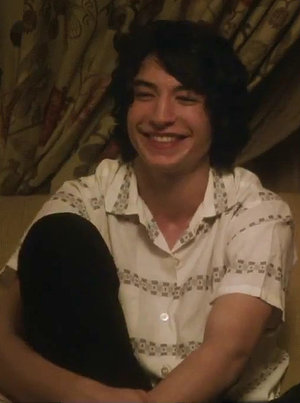
Patrick is first introduced as being called Nothing. Charlie states that someone told him that people use to call Patrick Patty and once day Patrick told the people to either call him Patrick or nothing...so they started calling him Nothing. However, Patrick is only called Nothing by Charlie for a couple 'chapters'.
Like Sam, Patrick is one of Charlie's first friends and he isn't shy about any topics. He often gives Charlie advice and explains some things to him.
Patrick is Sam's step-brother and lives with her, her mom, and his dad. He is also secretly dating the school's quarterback, Brad...which is why he takes an interest in football. Unlike Brad, he is openly gay and doesn't seem to care what people think about him.
Themes:
Now that you know the three main characters, let's discus some themes. This book is packed with themes. There's everything from music to rape in The Perks of Being a Wallflower. In order to get through quite a few of them, I'll be breaking them up into sections. This way we'll be able to discus each one individually instead of having them blend together.
Take note that any italicized words came directly from the book and I do not own them. Stephen Chbosky owns them and whoever owns the pictures I'm using for this post owns them. Claro? Okay, good, let's move on to our first theme...
 Rape:
Rape: Yep, that's right, we're going to start the themes off with this nasty little bugger. Unfortunately, this one is present in one of Charlie's memories.
When talking with Sam and Patrick one night, Charlie recalls a time when he was little and his brother threw a party while their parents were gone. His brother and sister had basically locked him in his room for the duration of the party. This didn't bug him too much because he was good at keeping himself busy.
However, while in the room, a couple of teenagers interrupted him. Up until the night he spoke to Sam and Patrick about it he hadn't realized what had actually happened that night. He hadn't thought on it enough to realize it.
Yet, while telling Patrick and Sam about the memory, he realizes that he had witnessed a rape. Naturally, he's not sure what to think about the realization at first. That is when he starts to see that some of his 'innocent' memories were stained by other people. Like the boy who rapped the girl, while Charlie was int he room, ruined a childhood memory.
Molestation:
This theme I'm not going to touch on too much because to go in depth in it I would have to give you some major spoilers for the book. All I'm really going to say about this topic is that it is very much present in the story. It is manly present in the form of memories...the memories of Charlie's friends. Sam, as well as a few other characters, all recall moments when they or people they know were molested. Charlie even talks about family members of his that were molested.
Music:
Music plays a huge role in The Perks of Being a Wallflower. The reason for this being that Charlie uses music to describe moments and feelings. He believes that there is music for every moment and has a special playlist that fits his life. The song Asleep (The Smiths) is mentioned multiple times in the story and is Charlie's favorite.
Music is even used as a way to define popularity. Charlie states at one point that:
"Patrick actully use to be popular before Sam bought him some good music."
Literature:
Literature, like music, is something that Charlie loves and uses to explain things. His teacher, Bill, introduces him to books such as To Kill a Mockingbird and The Fountainhead. For every extra book Bill gives him -for Bill gives him books outside of class to read -he writes an essay. The essays he writes helps to not only understand the books, but the world around him. Towards the end of the book, Charlie gathers up all the books Bill gave him and separates them into two sets. One set he gives to Patrick, the other to Sam. He makes sure to give them books that he's sure they would either benefit from or find absolutely interesting.

Homosexuality:Homosexuality isn't a hidden theme in this book. In fact, it's pretty obvious. There are two main homosexual characters, as well as a few that are only briefly mentioned. The first main character is Patrick, obviously.
Patrick is openly gay and readers are lead to believe that his parents accept it. This is because the book never states otherwise otherwise. He has a very supportive family and is in love with his boyfriend.
His boyfriend, however, is not as open about his sexuality. Brad, the second main homosexual character, is Patrick's boyfriend. He is the quarterback of their high school's football team and is closested. He at first blames alcohol for hooking up with Patrick but reaches a point where he no longer uses the alcohol as an excuse.
Brad keeps his sexuality hidden from everyone except for Patrick, Sam, and Charlie for the entire book. There is a scene where his dad catches him and Patrick together and it is during that scene that readers learn of the intolerance his family has for homosexuals. What takes place in that scene ends up effecting Brad and Patrick's relationship in a negative way.
Sex:
With the rape, molestation, and a couple scenes, sex is something that's mentioned quite a bit. Everyone of Charlie's friends has their opinion on the topic and their own pasts regarding it. Again, I won't go too in detail on this topic, but it is something that is spoken of repeatedly in the story. Sometimes it is given a good light, others it's placed under the darkest.
Abuse:
Both mental and physical abuse take place in The Perks of Being a Wallflower. Charlie mentions having to attend counseling sessions because of things that have happened to him. You don't find out what exactly it is that causes him to attend the sessions until the end, and all I'm going to tell you is that it falls under this topic as well as another on this list of themes.
Charlie mentions his aunts and grandmothers being abused, as well as witnessing his sister's boyfriend hitting her. He spends a few pages of the book talking about how he can see a trend of abuse in his family and swears that he'll never let his own kids experience what his female family members had gone through.

I'm combing theses two themes/topics because they often take place together.
When Charlie first meets the group of friends that Patrick and Sam hang out with, he is exposed to weed and alcohol. After that, he smokes, takes some pills, and drinks occasionally.
Needless to say, drinking and drugs is not uncommon among his friends. They even know, and party at, a dealer's home.
Common High School events/feelings:
 First day of high school... homecoming...football games...driving around town, while blaring music...prom...graduation...feeling alone...feeling like one is an outcast...finding that one group of people you belong in...everything is touched on in this book. Many of the experiences Charlie and his friends experience are things that all high school students experience.
The characters find themselves searching for their identities, falling in and out of love, giving up and moving on, and realizing just how big the world is. Despite having depressing and questionable themes, this book would be a great read for high school students. It would not, however, be a book a teacher would want to read aloud with the class. I could, however, see a teacher giving the book as an assignment and giving worksheets/having discussions about it in class.
Friendship/Unity:
 Friendship and unity are going to be the last themes I speak of, even though there are more I could. If there is a core theme to this book it is probably a combination of theses two. They are weaved through the book from beginning to end. From the opening words of, "Dear friend, I am writing to you because she said you would listen and understand and didn't try to sleep with that person at that party even though you could have." to the closing ones of, "So, if this does end up being my last letter, please believe that things are good with me, and even when they're not, they will be soon enough. And I will believe the same about you. Love always, Charlie." friendship and unity are present.
I could try to explain theses two themes all night but I would not be able to do them justice. It is because of theses themes that I would like to see the book taught in schools. They are so powerful that they outshine all of the darkness in the book. There's no way I could do theses two themes justice with my words, so let me use some of Charlie's words. Here's two quotes from The Perks of Being a Wallflower about them:
"Sam and Patrick looked at me. And I looked at them. And I think they knew. Not anything specific really. They just knew. And I think that's all you can ask from a friend."

"Sometimes, I look outside, and I think a lot of other people have seen this snow before. Just like I think a lot of other people have read those books before. And listened to those songs. I wonder how they feel tonight."

The last thing I really want to speak about is the language and style of The Perks of Being a Wallflower. The author chose to write the book in letter format, meaning there are no chapters...only letters. Each letter is a chapter, in a sense, and are pretty short. It'd be really easy for someone to finish this book in a single day, that is if they didn't have to keep stopping like I did to think about what they've just read.
As an example of the format Chbosky uses, the following is one of the shorter letters from the book. The following is taken directly from the book:
"November 12, 1991
Dear Friend,
I love twinkie, and the reason I am saying this is because we are all supposed to think of reasons to live. In science class, Mr. Z. told us about an experiment where they got this rat or mouse, and they put this rat or mouse on one side of a cage. On the other side of the cage, they put a little piece of food. And this rat or mouse would walk over to the food and eat. then, they put the rat or mouse back on its original side, and this time, they put electricity all through the floor where the rat or mouse would have to walk to get the piece of food. they did this for a while, and the rat or mouse stopped going to get the food at a certain amount of voltage. then, they repeated the experiment, but they replaced the food with something that gave the rat or mouse intense pleasure. I don't know what it was that gave them intense pleasure, but I am guessing it is some kind of rat or mouse nip. Anyway, what the scientists found out was that the rat or mouse would put up with a lot more voltage for the pleasure. Even more than for the food.
I don't know the significance of this, but I find it very interesting.
Love always,
Charlie"
Closing:
In my opinion, The Perks of Being a Wallflower is a great book. I really enjoyed reading it and I found myself relating to the Character of Charlie on a level that I didn't originally think I would. The 'constantly thinking' problem he has is something that I can relate to.
I look forward to seeing the movie when it comes out. Yes, it's going to be a movie :) This makes me excited...I just hope the movie industry doesn't end up butchering it like they have a habit of doing with books they turn into movies.
The trailer looks wonderful for it, though. Here's the trailer if you're interested in watching it.
Well, there you have it, ladies and gents! My thoughts on The Perks of Being a Wallflower. For whatever reason you chose to read this long post about a book that I loved, I hope you enjoyed it :)
Wednesday, August 29, 2012
Summer Has Come and Gone
Do you hear that?
The rumble of cars can be heard as they drive up to a large brick building. Doors open and out step children, dressed for the day with backpacks on their shoulders and sneakers on their feet.
"Goodbye Mommy!"
"Goodbye Daddy!"
"Bye mom."
"Bye dad."
"See ya later."
"Whatever...bye."
The children bid their guardians goodbye as they take those first steps of the school year. You know, the ones that lead them to the glass double doors. Their minds are filled with thoughts, so many in fact that they think they might just spill out their ears and run like sparkling ink down their arms and legs until meeting the concrete.
Just what awaits them on the other side of those doors?
There'll be teachers for sure, students, lockers, and noise. There'll be bells and intercoms. There'll be rules and regulations. There'll be homework.
Homework...one of the most dreaded things about school. Peers...that's another.
"Who will I be this year?"
"Am I still cool?"
"What if I'm an outcast?"
"I can't commit social suicide."
"Right choices. Right choices. Right choices."
"Have to hit the books...who cares what those jocks think?"
"What if I don't make Quarterback?"
"What if I get kicked off the Cheer Squad?"
Doors are pushed open and students tumble inside. It's the first day of school and the halls are filled with busy body's. Chatter has already resumed between friends as they talk about their summer adventures. Teachers unlock doors and lay out their lessons. Yes, indeed, it is the first day of school.
Summer has ended.
The yearly time for sunshine and games is over. It has been replaced with brick walls and notebooks.
My summer has come to an end, and I am sorry that I haven't posted at all over it. So many wonderful things took place over my summer vacation. I got to experience things and meet people that I wouldn't have if I hadn't had the opportunity to spend my summer working in a school.
The children I worked with over the summer opened my eyes, once again, to the vision (which is what I call the world in which writers dwell). I had been feeling disconnected from that world and had experienced writers block on more than one occasion, yet the children I meet helped stop that.
The amazing thing about children is that they are pure imagination. One could say they are even imagination incarnated. There is nothing like a child's imagination. The things they can dream up are marvelous.
I was truly blessed this summer and I cannot say that I regret anything that took place. Sure there were a few down points, what with all my friends being in different cities/towns/states than I, but all in all it was decent.
Since I've returned to college, I've been re-reading over my old blog posts and I've noticed a trend developing. It seems this blog has become mostly about English and literature. Right now my plan is to continue this trend. I plan on giving you book reviews, thoughts on life, quotes from my English classes, and even short stories/poetry from time to time. Basically, this is an English haven. Mostly everything posted here will relate to my major (English), literature, and language. I say mostly because I may throw in an odd post every once in a while about other things. You never know with me. I write what's on my mind and if something weighs heavy enough on my heart and mind you'll hear about it.
I do hope all of your summers were wonderful and that this upcoming fall only offers more opportunities for joy. Open your minds and hearts and you may just be surprised by what comes with the autumn leaves.
The rumble of cars can be heard as they drive up to a large brick building. Doors open and out step children, dressed for the day with backpacks on their shoulders and sneakers on their feet.
"Goodbye Mommy!"
"Goodbye Daddy!"
"Bye mom."
"Bye dad."
"See ya later."
"Whatever...bye."
The children bid their guardians goodbye as they take those first steps of the school year. You know, the ones that lead them to the glass double doors. Their minds are filled with thoughts, so many in fact that they think they might just spill out their ears and run like sparkling ink down their arms and legs until meeting the concrete.
Just what awaits them on the other side of those doors?
There'll be teachers for sure, students, lockers, and noise. There'll be bells and intercoms. There'll be rules and regulations. There'll be homework.
Homework...one of the most dreaded things about school. Peers...that's another.
"Who will I be this year?"
"Am I still cool?"
"What if I'm an outcast?"
"I can't commit social suicide."
"Right choices. Right choices. Right choices."
"Have to hit the books...who cares what those jocks think?"
"What if I don't make Quarterback?"
"What if I get kicked off the Cheer Squad?"
Doors are pushed open and students tumble inside. It's the first day of school and the halls are filled with busy body's. Chatter has already resumed between friends as they talk about their summer adventures. Teachers unlock doors and lay out their lessons. Yes, indeed, it is the first day of school.
Summer has ended.
The yearly time for sunshine and games is over. It has been replaced with brick walls and notebooks.
My summer has come to an end, and I am sorry that I haven't posted at all over it. So many wonderful things took place over my summer vacation. I got to experience things and meet people that I wouldn't have if I hadn't had the opportunity to spend my summer working in a school.
The children I worked with over the summer opened my eyes, once again, to the vision (which is what I call the world in which writers dwell). I had been feeling disconnected from that world and had experienced writers block on more than one occasion, yet the children I meet helped stop that.
The amazing thing about children is that they are pure imagination. One could say they are even imagination incarnated. There is nothing like a child's imagination. The things they can dream up are marvelous.
I was truly blessed this summer and I cannot say that I regret anything that took place. Sure there were a few down points, what with all my friends being in different cities/towns/states than I, but all in all it was decent.
Since I've returned to college, I've been re-reading over my old blog posts and I've noticed a trend developing. It seems this blog has become mostly about English and literature. Right now my plan is to continue this trend. I plan on giving you book reviews, thoughts on life, quotes from my English classes, and even short stories/poetry from time to time. Basically, this is an English haven. Mostly everything posted here will relate to my major (English), literature, and language. I say mostly because I may throw in an odd post every once in a while about other things. You never know with me. I write what's on my mind and if something weighs heavy enough on my heart and mind you'll hear about it.
I do hope all of your summers were wonderful and that this upcoming fall only offers more opportunities for joy. Open your minds and hearts and you may just be surprised by what comes with the autumn leaves.
Sunday, April 29, 2012
My Thoughts On...The Body Of Christopher Creed
I just finished reading The Body of Christopher Creed (by Carol Plum-Icci) for my teaching young adult literature class, and if I were to sum up the book in one word it would be, "Wow".
When I first started reading the book I wasn't sure I would end up liking it. Firstly because I don't read many mystery books, because my imagination tends to get the best of me, and secondly because I didn't much like the idea of reading about a murdered teenager. I have to say though, before I continue on, that I was pleased with how the book turned out.
The story starts out with the main character, Torey Adams, saying:
"I had hoped that a new start away from Steepleton would make my junior year seem like a hundred years ago, rather than just one. Granted, senior year is not a great year to be switching schools, especially if you played football, baseball, had a decent blues band going in your basement, and had known the same kids since forever. I kept telling myself at first, Hey, going to boarding school will be like leaving for college a year early. It's cool. But that's a hard argument to hold on to when you're looking at people whose average age is fifteen, and when we're still living under a 10:00 P.M. weekend curfew in the dorm, At first it was a weird change. But staying in Steepleton after all that had happened would have been weirder."

Because of the above, we automatically know that whatever when down in Steepleton must have been big if it caused Torey to flee to another school. It makes readers interested as forces them to ask the question, "What happened and why are you running?"
As the book continues, Torey begins to tell his story and we learn about the missing boy named Christopher Creed. Now, I'm going to tell you the whole story, and I most certainly won't tell you the ending, but I will give you a quick summery. The following is the current summery I have written for the project I read this book for. It lacks many details but should get the point of what's going on across to you.
Summary:
A high school student by the name of Christopher Creed has disappeared. There are no signs of a kidnapping and a note left behind -from Creed -throws the town of Steepleton into chaos. By the wording of the note, no one can tell if it Creed planned to commit suicide or if he simply ran away. Fellow classmate, Torey Adams, has known Creed since Kindergarten and when the school’s reject goes missing he takes it upon himself to find the kid.
Torey’s search leads him to make some unlikely allies in the form of the school’s ‘slut’, Alie McDermott, and a boon called Bo Richardson. The three of them set out to discover what exactly happened to their classmate. However, when Chris’ mother starts blaming Bo of killing her son things get messy. The teens find themselves thrust into a world they’ve never seen and it opens Torey’s eyes to the fact that Steepleton, and its locals, are not as perfect as everyone says.
He learns who his true friends are when his best friend, Alex, and Alex’s girlfriend, Renee, start thinking that not only did Bo kill Chris but that Torey helped him. Wanting to prove both his and Bo’s innocence, Torey is determined to find out the truth behind Creed’s disappearance.
The story that Carol Plum-Ucci presents to readers brings up many themes and at times it was difficult to read. It was an uneasy read that had me sometimes watching the shadows around me. Though it was enjoyable, it hit on some themes that made it hard to swallow sometimes. There were even a few things mentioned in it that I recognized having witnessed in my own high school.
For the sake of explaining each theme I want to talk about accurately, I will divide them up and give a quick response to each.
Homosexuality:
This theme is only touched on once in the book and at the very beginning. Torey mentions some fellow students thinking a kid named Leo is gay. He states that there are two other gay guys living in the dorms, but no one cares because they were open about it. He makes a point of saying that it wasn't really the possibility of Leo being gay that bugged people, it was the fact that you could tell the kid was struggling with something and knowing that he was made you struggle as well.
Sex:
This is not really a theme so much as it is something the characters talk about frequently. There are characters that are accused of being sluts, characters that are said to be virgins, characters that claim not to sleep around but actually do, and characters that actually seems to think of sex as being something special. Honestly, there were a few times that I thought, "How could a teacher teach this book to her/his class without feeling awkward," but the scenes were nothing that students wouldn't have already read. In fact, most of the scenes with this theme in it were mainly conversations of the topic or a characters thoughts on it. They were tings that teens would actually talk/think about.
Gossip:
Gossip and the harm it does is a big theme in this book. In fact, I'd say it's one of the main ones. Through the book Torey notices how much of gossips his friends really are and how much harm they are actually causing. The boy has his eyes opened in many ways in this book and faces revelations that many teens are forced to.
Human Faults:
One of the big things Torey learns during the story is that there is no such thing as a perfect life. After starting up a friendship with Allie he slowly starts realizing that his friends' 'perfect' lives were not as pristine as everyone pretended they were. In fact, he learns that Steepleton itself has a hidden past. As he says at one point in the story, Christopher Creed -the weird kid -might have disappeared but his disappearance only brought out the weirdness of everyone in the town...and that weirdness ends up revealing a lot about the town's inhabitants.
Something Interesting:
Now this is not a theme, this is something I merely observed. Being an English major, I tend to pay attention to the language and style author's use. The slang Carol Plum-Ucci used really caught my attention. I liked how the author kept the story in Torey's point of view -keeping to first person -and in that teenage slang was used. I had to laugh though, a few times :) You see, the slang used in the book isn't exactly common today. Of course this is because the book is not a new write and takes place in the past, but I still gained amusement from it a few times. Slang and insults such as, "You're wigging out," "Quit wigging," "You sound like you were cutting logs (referring to sleep)", and "She's a turbo-slut" sprang up repeatedly.
I swear half of the lingo used in the book I had never heard before. I even asked my roommate on a few of them and she hadn't heard of them. It kept the story interesting though. One thing I wasn't impressed with, but understand why the author did it, was the amount of curse words used in the book.
The F-bomb, as well as a few others were used throughout the book by the characters. The cursing is understandable, considering many teenagers talk like that, but it's another reason to question whether it should be used in the class room setting.
While reading The Body of Christopher Creed, I was constantly toying with the thought that it shouldn't be presented in classrooms. I had spoken to a friend who said she had read the book in sixth grade and another who had said she had read it in eight. Honestly, six grade is a bit too young to be reading this book. I have a younger sister in fifth grade and I will not be encouraging her to read this book. Only my high school aged siblings will be allowed to take it from my book shelf due to the themes and language used in it.
As for eighth graders...I'm iffy. I could see how you would want them to read it, but I think -and this is strictly my personal opinion -that they are still too young for many of the themes presented in the story. Technically, the book could be consider a late middle school to high school read, but I wouldn't want to present it to a class younger than sophomore year of high school. If I had to teach it, I would prefer that it be to a Junior level class. This is because the characters in the book are Juniors in high school and the situations they face and themes that appear often take place during that age.
Overall, the book it great and I will most likely read it again in the future. The ending of the book had me convinced that it should be used in a classroom setting. I won't tell you what the end is, because I don't want to spoil the story for anyone who wishes to read it, but what Torey eventually comes to realize is important and I think there is a valuable lesson to be taken from it...a very valuable lesions actually.
I look forward to reading the sequel and will most likely start on it tomorrow...if I get the chance. I also encourage any of you above ninth grade to read it. I took something away from it and was able to connect with some of the things mentioned in it. I think it is an awesome read.
Book Trailers:
The following are a couple of fan made trailers I found for the book on YouTube. I thought they were pretty cool and would show them to you.
<iframe width="420" height="315" src="http://www.youtube.com/embed/AQGVeC0Gwcw" frameborder="0" allowfullscreen></iframe>
<iframe width="420" height="315" src="http://www.youtube.com/embed/gJVwdbRp6cU" frameborder="0" allowfullscreen></iframe>
Wednesday, April 11, 2012
The Joys of English
So, I found this list on the internet at http://www.thecampuscompanion.com/2011/01/25/you-know-youre-an-english-major-if-part-2-of-a-series/ and thought I'd put it up here in a sort of check list format. This way I can see exactly how many of them I fit and you can see if you fit any of them too, if you so desire. By the way, my opinions/answers to each statement are the words in bold.
Thinking about it, us English majiors do make a lot of references to literature and joke about authors a lot. One of my favorite ongoing debates amongst all of us though is wether or not Shakesphere actully wrote all of his plays. I honestly don't think that debate will ever be finished.
- People’s everyday grammar and vocabulary make you cringe (Yes, I'm okay with most of it but real hic langauge makes me cringe)
- You believe that you are mentally and socially superior to all other majors (No)
- You want to become a teacher (...maybe...)
- You want to become a journalist (NEVER!!!!! I shall NOT restrict myself to facts)
- You are a teacher/journalist (Ha, no! I haven't even graduated college)
- You know the difference between “its” and “it’s” (Yes. It's is an abbreation for It Is, where 'its' is when it has something)
- People’s grammar and usage on facebook horrify you (Some times. Gangster langauge and text talk irritate me...yet I'm guilty of using text talk. It's convenant when one's too lazy to write out a whole word)
- You know the difference between “their” and “they’re” (Yes! Yes! Yes!)
- You write for the school newspaper (Nope)
- You know what a “gerund” is (...I do now...Google is a wonderful invention, isn't it?)
- You regularly make use of Sparknotes (Guilty as charged!)
- You are tired of being asked what you thought was “significant” and… here it comes… Why? (Amen whoever wrote this! Those are problably the most asked questions in the English majior)
- You’ve spent an entire day writing a paper (Yes)
- You’ve gotten an A or a B on a paper you wrote at 2:00 in the morning (Hehe, yeah. Most of my best work is done in the early hours)
- You’ve gotten an A or B on a paper defending a position that you don’t even agree with (Yeppers)
- You’ve gotten an A or B on a paper that you don’t recall writing because you were blacked out, and the professor wrote a comment praising its “fluidity” (Define blacked out....I have gotten and B on a paper that I didn't remember writing, but it was durring a week where I had papers due almost everyday and I honestly couldn't tell which ones I wrote and which ones I took a grade on)
- You have an insane number of chapters to read tonight (I always have an insane number of chapters to read)
- You have a personal relationship with William Shakespeare (Well, no. He's dead. No one has a PERSONAL relationship with him, anymore. He is one of my favorite playwrites though)
- You’re convinced you can make a living writing poetry and/or novels (Want to = Yes, convince =No)
- You have a pet named after an author or literary character (Not currently, but I did last year)
- You regularly invent bad puns, and your friends want to kill you for it (Hehe, sometimes)
- You look down on anyone who wants to ban a book (YES! You have no right to ban a book...expecilaly not in America. Freedom of speech people! Now, you can put age restrictions on it, for example I wouldn't want a 10yr old reading Stephen King, but don't completly ban the book)
- You use famous quotes in much of your conversation (Some times)
- You consider authors to be sex symbols (What?!?!?! Uh...weird)
- You analyze everything you read in terms of where the prepositional phrases are (No)
- You’re offended by statements like “no more than six pages, please” (Yes)
- You analyze things constantly and impulsively, often more than is needed (Kind of have to. If I don't then I end up not analyzing things enough and end up failing my paper on the subject)
- You know that everything in the universe relates to English literature (There are many other things that it all relates to, and it's not just English literature. I, myself, happen to be a fan of Irish literature and British literature)
- You want to learn a foreign language so you can read things other than English literature (Been there, done that, love reading things in another language)
- You want to analyze how that other literature relates to the universe, and to English literature (yes)
- You want to consider the significance of said relationships and why they are significant (sure)
- You regularly get in arguments about correct grammar (Yes!)
- You shout “ONOMATOPOEIA!” whenever your friends use one (Hey! I randomly shouted that word today!)
- You know when and how to use “lie” and “lay” (Now there's a tricky pair, but yes...if I think about it)
- All of your classes encourage the “Socratic method” and have the desks arranged in a circle (I wish)
- You go to English classes that you aren’t actually signed up for, just because you’re excited about them (Why would I do that? I don't go to anymore classes than I have to, because as much as I love English I'd rather spend my free time writing)
- You spend more money on books than you do on food (Guilty)
- You go to the library more often than you go to rock concerts (Yes)
- You know that absolutely everything you write must have a thesis statement, upon penalty of death (In some shape or form, yes...but I dislike creating them for research papers)
- You know that every source must be cited, upon penalty of death (Absolutly! And it must be done in the correct format...I perper MLA to APA...but that's just me)
- You know that only one of your cited sources can be a website (Yeah, I've deviated from this one a few times...)
- You know that nobody expects the Spanish Inquisition ( :P )
- It bothers you when people say “neither… or” (shrugs, actully that one doesn't bug me as much as others)
- You don’t understand why your friends laugh when you talk about how thick Moby Dick is (Hated that book, and if you put your mind in an imature mind set it's easy to figuire out why they're laughing. Seriously, who words things like that?)
- You know the ins-and-outs of MLA format (YES! YES! YES! My all tiem FAVORITE format!)
- You know that there are other formats besides MLA format (Yes...I extremly dislike you APA. People say you're simple, I say you're a pain in the butt)
- You know the ins-and-outs of them, too (So what if I do? Doesn't mean I like to use them)
- You’ve fancied becoming a hippie (Maybe *gives too innocent of smile*)
- You aren’t bothered by the idea of being homeless (Not really. Though I'd rather not be)
- You correct other people’s spelling, but shudder at the thought of them catching mistakes in your own (I don't pretend that my spelling is perfect. I know for a fact that it's horrible)
- You, unlike most of your classmates, can actually understand dialects (Yes)
- You use Shakespearean insults (I bite my thumb at you sir! Is that enough of an answer for you?)
- You favor the English spelling system over the American one (Yes)
- You need a calculator to know what 7×9 equals (Yeah...math is my enemy)
- You posit that the book is always better than the movie (Always)
- You spend years trying to understand “the human condition”
- You are currently reading 5 or more books at once (Clockwork Prince, Stranger, The Hatchet, The Island, A Picture of Dorian Grey, and part of Ulysses....um, yep, more than five)
- You know that the backbone of a strong argument is the text that supports it (Yep)
- You keep a running list of books you’d like to read (Yep)
- You keep a running list of books you’ve read (Yep)
- You keep a running list of books you’d like to read again (Yep)
- You have what you consider to be a personal library (No doubt about it)
- You have enough books in said personal library to start a new public library (Problably)
- You always encourage others to read more, even though you know they won’t (Yes)
- You swap books with your friends because they have to read yours and you have to read theirs (Ocassionally...I have an odd collection of books I want to read so I normaly just end up buying any that I wish to read...even if my friends have them)
- A book is the best Christmas or birthday gift you can think of (Always on the list)
- You have friends who are science majors and don’t understand “why reading all day is so hard” (Yes)
- You are constantly asked “where you plan to go” with your studies (Yes)
- You are tempted to answer “Jamaica” to the above question (Haha, my answer's Moscow, but I guess Jamaica works too)
- You are seriously considering a career as a librarian (Yep, applying for a summer position)
- You feel guilty when you walk out of a bookstore without buying a book (Nope...I feel sad, but my bank account is happy)
- You have to know what year a book was written in, and who it was published by, just in case you have to cite it (Year, yes...that determins what the language style will most likly be like...publishing company, only ocasionly)
- You make a mental list of words to look up in the dictionary (A mental list? I look them up right a way)
- You know that “bada-bing” is in the dictionary (Yep)
- You keep tabs on which words are added to the unabridged dictionary each year (No)
- You like to do things that make you “feel intellectual” (Sometimes, but sometimes I just liek to be lazy)
- You’d rather compose a thoughtful haiku about the moon than build a base on it (Ew! Haikus! Please, no. I'll write you a free verse, even one with a set pattern, but no Haikus. I HATE writing Haikus)
- You know how to spell Supercalifragilisticexpialidocious (Not off the top of my head. I can't even tell you if yous spelled it right)
- You’ve catalogued every case of consistent alliteration throughout the course of this… crummy… list (No, I'm not that bored)
- You’ve already started writing an essay about the significance of this list, why you find it significant, and how that main idea relates to the “human condition” (Fiction writer...I don't care about the how this list relates to the "human condition")
- You hate it when people end sentences with a preposition (Yes, but I'm guilty of doing it)
- You can conjugate any given verb in future perfect tense (No)
- You know what “future perfect tense” is (Nope)
- You understand the concept of “literary license” (yes)
- People with other majors regularly ask you to edit their papers (Yes)
- Writing and/or editing others’ papers is actually a steady source of your income (I wish)
- You know how and when to use “who” and “whom” (yes)
- When reading a novel, you pause to analyze the author’s writing style (Yes)
- You get annoyed when non-English majors get excited about their “poetry” (No)
- You get annoyed when non-English majors say they “would love to write a novel” (No. Why would that annoy me?)
- You’ve read something in Old English (Yes)
- You can actually understand Old English (Yes)
- You’ve memorized the first line of at least five novels (Yes)
- Typos of any kind throw you off, and in some cases make you angry (Not always)
- You’ve considered how this list might be rewritten in free-verse (It could be)
- You’ve considered how this list might be rewritten in iambic pentameter (It could be)
- You’ve considered how this list might be rewritten, period (Are you really THAT bored?)
- You found at least one misspelling or grammatical error in this list (Yes, actully...but I wasn't sure exactly how to corect it so I just left it as it was)
- You’re too busy reading and/or writing to bother mentioning it, or to write a list like this for that matter (Yeah)
- When you hear the name Zelda you think of F. Scott Fitzgerald and not video games. (Nope. I think of the video games. F. Scott Fitzgerald is one of those authors on me 'To Read' list that I haven't gotten to yet)
Thinking about it, us English majiors do make a lot of references to literature and joke about authors a lot. One of my favorite ongoing debates amongst all of us though is wether or not Shakesphere actully wrote all of his plays. I honestly don't think that debate will ever be finished.
Monday, April 2, 2012
Wonderland
Hey, I mentioned in an earlier blog that I was working on a poem that was loosly based on Alice in Wonderland. Well, it's nto finished yet (I don't think), but here's an update on how it's going :) This is what I have so far.
Topsey turvie,
Upside down,
My world's spinning faster,
I'm loosing my ground.
This, that,
Up or down,
Arrows pointing every way,
I'm nowhere to be found.
Tables turning,
Hands down,
Voices raised in passion,
We're going around and around.
Taught terrors,
Going down,
Against the old flow,
We're finding our own sound.
Troubled times,
Marching down,
the tiem has come,
This is our current battle ground.
Trails, tribulations,
Coming down,
Whatever comes we'll face,
There is no turning around.
Tales told,
Girl down,
Into the rabit hole,
Into a world underground.
That's it so far. It still needs to be rewritten, and I'm not so sure how I feel about the last stanza. Hopefully I'll ahve another version up soon though.
Topsey turvie,
Upside down,
My world's spinning faster,
I'm loosing my ground.
This, that,
Up or down,
Arrows pointing every way,
I'm nowhere to be found.
Tables turning,
Hands down,
Voices raised in passion,
We're going around and around.
Taught terrors,
Going down,
Against the old flow,
We're finding our own sound.
Troubled times,
Marching down,
the tiem has come,
This is our current battle ground.
Trails, tribulations,
Coming down,
Whatever comes we'll face,
There is no turning around.
Tales told,
Girl down,
Into the rabit hole,
Into a world underground.
That's it so far. It still needs to be rewritten, and I'm not so sure how I feel about the last stanza. Hopefully I'll ahve another version up soon though.
Subscribe to:
Posts (Atom)